Wuxi Huatong Pneumatic Manufacturing Co., Ltd.
HT. Pneumatic Manufacture
Classification and Working Principle of Directional Control Valves
Published: 2013-03-20 21:27:03 Views: 629 Source: Wuxi Huatong Pneumatic
Article Summary
Directional control valves (reversing valves) change airflow direction by altering internal passages, thereby controlling the motion direction of pneumatic actuators. Types include: pneumatically piloted, solenoid-operated, mechanically actuated, manually operated, and time-delay valves.1. Pneumatic···
Source: Wuxi Huatong Pneumatic Manufacturing Co., Ltd. Published 2013-03-20
Directional control valves (reversing valves) change airflow direction by altering internal passages, thereby controlling the motion direction of pneumatic actuators. Types include: pneumatically piloted, solenoid-operated, mechanically actuated, manually operated, and time-delay valves.
1. Pneumatically Piloted Directional Valve
These use air pressure to shift the main spool. By control method: pressure-actuated (signal pressure rises to shift), vent-actuated (signal pressure drops to shift), and differential-pressure actuated (spool shifts due to pressure difference across ends).
By structure: poppet-type and spool-type. Spool-type valves resemble hydraulic directional valves. Here we focus on poppet design.
Poppet Valve Working Principle
Fig. 1 shows a 2/3-way, single-pilot poppet valve. Without pilot signal at port K (Fig. a), spring and P-pressure keep P disconnected from A; A vents to T. With pilot signal at K (Fig. b), P connects to A, and A is isolated from T.

Fig. 1: Poppet-type directional valve principle
Fig. 2 shows its construction. No signal at K: A–T open (exhaust). Signal at K: air enters right side of piston (9), moving valve stem (5) left to connect P–A. Shown is normally closed; swapping P and T yields normally open.
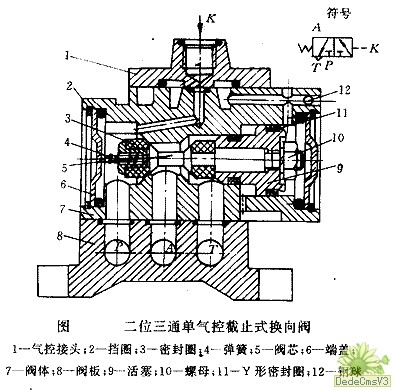
Fig. 2: Poppet valve structure
2. Pilot-Operated Solenoid Valve
Fig. 3: Direct-acting single-solenoid valve principle
Pilot-operated valves use a small solenoid to generate pilot pressure, which then shifts the main spool—ideal for larger port sizes.
Fig. 4 shows a pilot-operated, double-solenoid, 2/4-way valve with memory function. It comprises pilot valves (D1, D2) and a main valve (body 1 + piston assembly 2). When D1 energizes, pilot air flows to chamber f, pushing piston 2 down: P→A, B→T. A portion of output air seals the exhaust via a check valve, providing memory—state remains even after de-energizing. Similarly, energizing D2 reverses flow (P→B, A→T) with memory retention due to piston area differential.
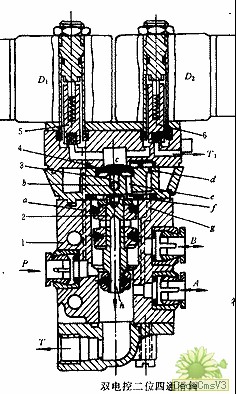
Fig. 4: Pilot-operated double-solenoid 2/4-way valve
Previous: Common Faults of Solenoid Valves and Solutions Next: Solenoid Valve Installation Precautions
Back to Solenoid Valves Related Articles
- 2013-05Use and Maintenance Guide – Pneumatic Directional Control Valve
- 2013-04Critical Solenoid Valve Installation Precautions
- 2013-04Solenoid Valve Fundamentals: Principle, Classification, and Applications
- 2013-04Understanding 2/3-Way and 2/5-Way Solenoid Valves
- 2013-04Key Points to Consider When Selecting a Solenoid Valve
- 2013-04What Is a Pilot Diaphragm Solenoid Valve?
- 2013-04How to Select the Switching Mode of a Solenoid Valve?
- 2013-04Working Principles of Common Solenoid Valves
- 2013-03How to Troubleshoot a Failed 2/3-Way Solenoid Valve?
- 2013-03How to Select the Correct Solenoid Valve Port Size?